Sunday, January 2, 2022

Daily art -- a new challenge for 2022

 Faithful readers know that I have been doing daily art for 20 years, revising my rules every January 1.  After three years of doing calligraphy, I feel overdue for something new, so I decided to leap into the deep end of the pool with something I'm terrified of -- paint.  I'm even having a hard time describing it as "painting" rather than just "paint," much as a long time ago I had to ease into calling myself an "artist," instead first saying "I make art."
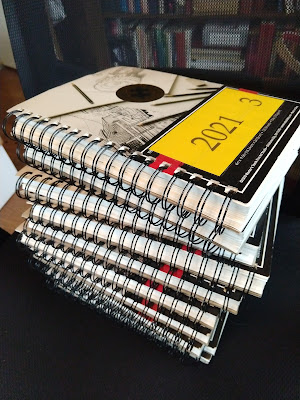
Three years of daily calligraphy


This is not a new situation for me.  In 2013 I forced myself to learn to make collage by way of daily art (and did it for three years).  I came to love it, incorporate many aspects and techniques into my "serious art," and would happily do it again as a daily practice.  In 2016 I forced myself to overcome my dread of drawing, even joining a life-drawing group and enrolling in a beginning college art class, where I got an A+.  I learned to make better realistic renditions than I did at the start of the year, but I couldn't force myself to stick with realism.  I quit the drawing group and by the end of the year was filling my sketchbooks with maps, repetitive patterns, doodles and increasingly abstract line work.

So with one success and one failure in my past, I'm trying again.  I've always avoided anything that you could describe as "painting," although I have used plenty of paint in the last decade.  Why the terror, considering that I love to have paintings by other people all around me?  I can think of several possible reasons.

For one, I've always rankled at the concept that painting is "real art," whereas fiber is some kind of second-tier impostor medium that is only grudgingly allowed into museums and galleries.  So if that's the way they feel about it, to hell with painting, I'll do anything but.  A childish opinion, which doesn't even hold up very well under cross-examination, but there it is.

For another, I have never felt comfortable using a brush to lay down color.  In three years of calligraphy I've tried many different writing implements, falling in love with many of them.  But brushes are not in that group.  Every time I try to write with a brush I think the result looks awkward and weak.  So unless I conduct my paint career exclusively with palette knives (not that there's anything wrong with that) I have a big hurdle to overcome.
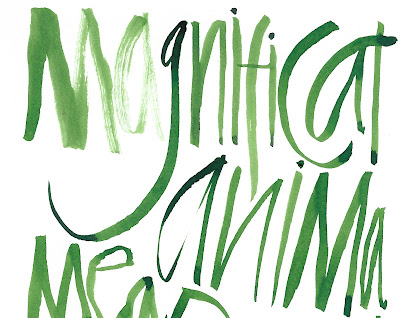
Just doesn't look that good to me....


Most important, I've always relished the freedom that fiber art, especially quilting, offers in terms of  design.  You make a little motif or sewed-together area and put it up on the design wall, and then add some more areas.  And eventually you can rearrange them till you get a pleasing composition.  If you think this red part should be closer to the bottom edge, cut off the extra stuff.  If you think it should be closer to the center, make some more piecing and add it onto the side.  If you think the two red bits should be farther apart, add something else in between.  By contrast, when you paint, you need a sound preliminary idea of where your elements are going to fall on the canvas before you start putting red things down.
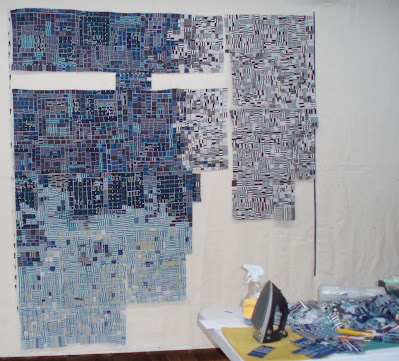
This is how I like to work!!
I have developed a pretty good sense of composition over the years but I almost always do it on the design wall, moving things around and auditioning and trying this and trying that before deciding on the final result.  I'm afraid that if I can't rearrange I will either end up with crappy compositions or be forced to (gasp! horrors!) make advance sketches.  And advance planning is NOT the way I like to work!  I like to think by doing.  But I have no idea how that's going to work with painting.

I've done one painting so far.  I am using an interesting technique to make myself overcome terror and paralysis, which I'll tell you about soon.  


Thursday, December 16, 2021

Daily art -- the end of an streak

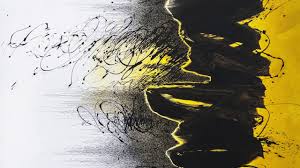
Two weeks from tomorrow will be my last daily calligraphy.  After three years on this streak, it's time to stop.  I have accomplished a lot with this practice, although not what I intended to do when I started.  At that time I had just seen and fallen in love with the work of an Iranian artist, Golnaz Fathi, who used calligraphy, or maybe I should say marks that resembled calligraphy -- especially this painting:

Golnaz Fathi


I thought that in a year of writing I could figure out how to achieve a similar effect, that it was just a case of finding the right ink/paint and the right brush/pen and developing a personal style of making letters.  Turns out that in three years I have not yet achieved that goal, although I think I have come close a few times.

I have learned many things in those three years.  First, that I am much more comfortable using a pen than using a brush.  I keep buying new pen nibs to add to my already huge collection, jump-started with a whole lot of pens inherited from my father.  But while he went for bold pens with wide or ball-shaped tips, I have been going smaller and smaller, in search of pens that are very flexible, going from narrow to wide in a single stroke as you add pressure.  I love the old-fashioned look that you get from plain old script written with a small pen.


Second, that it's harder than you think to do asemic writing, the fancy-pants term for writing that doesn't have any meaning.  To do this well you need a repertoire of symbols that look like actual letters but aren't.  In three years I did a pretty good job of developing my own personal asemic script, which is also nicely suited to the thick-and-thin flexible pen.


Third, despite the literal meaning of "calligraphy" -- beautiful writing -- I have become quite enamored of crude, non-beautiful writing.  It helps to have a pen or other writing tool that will produce irregular lines, maybe also some spatters, and that's not always easy.  My favorite beer-can pen got old and died last year, and a couple of new ones haven't given the same effect.  


Finally, the closest I have been able to come to the pictorial quality of Fathi's work has been by writing wet-into-wet.  This technique will serve me well for next year's daily art: painting.  I'll tell you more in later posts. 

Sunday, November 14, 2021

On the Road with Marti

One last post about my friend Marti Plager, who died last month.  She and I loved to take road trips together -- to Houston for the big quilt festival three or four times, to Quilt National four or five times, to Pittsburgh for Fiberart International, to Philadelphia for the international SAQA conference,  to Paducah several times for the quilt show, and to a whole lot of workshops, museums and galleries.  

Fifteen years ago I wanted for some reason to enter an art show at the Kerouac Center in Lowell MA.  The artwork was supposed to  have something to do with Jack Kerouac, and I really didn't know or care much about him, so I figured I needed a gimmick.

I did some research and found that when Kerouac sat down to write his famous "On the Road," he had a roll of newsprint wide enough to fit in his typewriter and very, very long.  He started writing at the top of the roll and just kept going.  So I thought I could come up with a roll of Kerouac-style writing too and get into the show. 


I called my piece "On the Road with Marti" and it is a lot of stream-of-consciousness-type reminiscence of some of the many road trips that we took together.  It's too bad the manuscript ends in 2006, because there were many, many more trips that didn't get documented.

I used a typewriter font, printed the manuscript onto rusted muslin, added cross-outs and edits by hand (as writers did in the olden days of typewriters) and quilted it into a scroll.  I don't know what Kerouac lubricated his road trips with, but Marti and I always used red wine, so there's a wine stain too.  And it got into the show.  


Saturday, October 30, 2021

How Marti saved me from the quilt guild ladies

I wrote about my dear friend Marti Plager, who died earlier this month, and promised to tell you how she singlehandedly set me on the path to quilting as art. 

In the mid-90s we had both been members of a big local quilt guild, but neither of us really felt at home.  It was the kind of guild where people would give show-and-tell of their latest quilt, and the first question was invariably "what pattern did you use?"  Those of us who did our own designs were regarded with suspicion if not downright disapproval.  Finally Marti decided she had had enough, and quit the guild.  I was reaching the same conclusion.

Marti and I didn't know one another except as faces in the crowd, but she had paid particular attention when I had show-and-tell of a quilt I had made for a contest sponsored by Quilter's Newsletter Magazine.  The contest was called "Rhapsody of Roses" and the rules called for at least one rose on the quilt.  I figured that the vast majority of the entrants would have beautiful roses all over the place, and I couldn't compete with beauty, nor with realism.  So I deliberately went in the other direction, and came up with a quilt that was almost all thorns, with one little rose in one corner.

Rose Among Thorns

sorry for the wimpy color -- this is a digitization from an old slide; the quilt is gone now so this is the only image I  have, unless I can find my copy of the QNM where they printed the contest winners

I explained my thought process to the guild, and showed my finished quilt.  I can't remember whether this occurred before or after the contest was judged, and I got the award for "best interpretation of theme" (a decision that still mystifies me...)  The guild ladies were not impressed, but Marti was.  A few months later she called me, reminded me who she was, and said she was getting together a small group of quilters who were doing original designs and aiming for art rather than bed quilts.  Would I like to join them?

Yes, of course, and for more than two decades this small group, with slightly changing membership, was my closest and most important support as I learned to become an art quilter.  Not only did I have to up my game technically and artistically, I had to learn how to enter shows, how to get my work photographed, how to ship quilts here and there.  

I suppose I could have figured out this stuff by myself, but it was so much easier and better to do it with friends.  Most important, we came to trust each other enough to both give and receive criticism and suggestions without being defensive (or offensive).

Over the years I've participated in many a discussion of support groups, and so often it ends with somebody else saying "I wish I could find a support group like yours."  Often people try to get with others, but find that the others are too judgmental, or too critical, or too arbitrary in what they like and dislike.  Or on the other hand, the others don't have high enough standards or work hard enough or are too easily distracted by distractions.  I never know what to say to these people except to keep trying; if one group doesn't work, maybe another will.  Or maybe if a group doesn't work, you can tweak the ground rules or the membership list and hope that in time the group will get better.

Rose Among Thorns -- detail

Our small group only did two joint projects in two decades.  Once we were asked to prepare a table setting to showcase the dinnerware made by a famous ceramist; we dyed and printed a fabulous tablecloth, napkins and placemats.  Once we ordered four dozen blank silk scarves and did a round robin in which each scarf was dyed or painted or printed by four different people.  The consensus was that we had fun but that wasn't what our group was about.

We didn't talk much about our families or our jobs, just the art.  We didn't have refreshments at our meetings.  We chose the next meeting date based on when everybody could be there, and somehow we almost always stuck to it, with all of us in attendance.  We all grew immensely as artists during our time together.  I don't believe I would have accomplished half of what I have done without that group of friends, and Marti was the one who started it all.


Saturday, October 16, 2021

Memories of a dear friend

I've had a deep loss this month with the sudden death of my friend and art pal Marti Plager.  Not only was she my oldest continuous constantly-in-touch friend -- dating back about 25 years -- she opened the door for my development as an artist/quilter.  If you've ever done workshops at the Crow Barn or Arrowmont, or attended Quilt National or Paducah or Houston or Form, Not Function, or gone to a regional or national SAQA or SDA meeting, there's a good chance you met Marti somewhere along the way, because she was not one to let any person in the same room with her go unmet. 

One of Marti's proudest moments was being juried into Quilt National in 2011.  Her whole-cloth quilt was dyed with flour resist, a technique she used brilliantly and taught in several local workshops.


Another of her great accomplishments was helping to start the juried show Form, Not Function at the Carnegie Center in New Albany IN.  When a tiny group of local fiber artists had a show at the Carnegie in 2003, the museum was surprised and delighted that so many people came in (even if many of them mistakenly expect to see traditional quilts),  Marti and I, along with the others in that show, suggested that the museum should put on a juried show and do art quilts every year.

The first FNF, in 2004, was limited to artists in Indiana and its surrounding states, but quickly expanded to the entire US.  For the first several years, the six members of River City Fiber Artists served as jurors, and we also would hang the shows, back when we were a lot more agile.  Marti was always the one to go up on the ladder.  Today FNF has an excellent national reputation and regularly draws entries from the top tier of quilt artists.

In several workshops with Carol Soderlund in the early 2000s, Marti mastered the art of dyeing, and explored many different techniques.  After good runs with flour resist and screenprinting, she mainly settled on dye-painting.  In later years, after moving to a smaller place with no good wet studio space, she went to her closet and found enough in her stash to make dozens of quilts with intricately pieced bits of her own dyed fabrics, like the one below, in Art Quilt Elements 2016.

You can see a whole lot more of Marti's work on her website.  I'm going to need at least one more post to tell you about my personal connection and how she changed my artistic life.  Stay tuned!